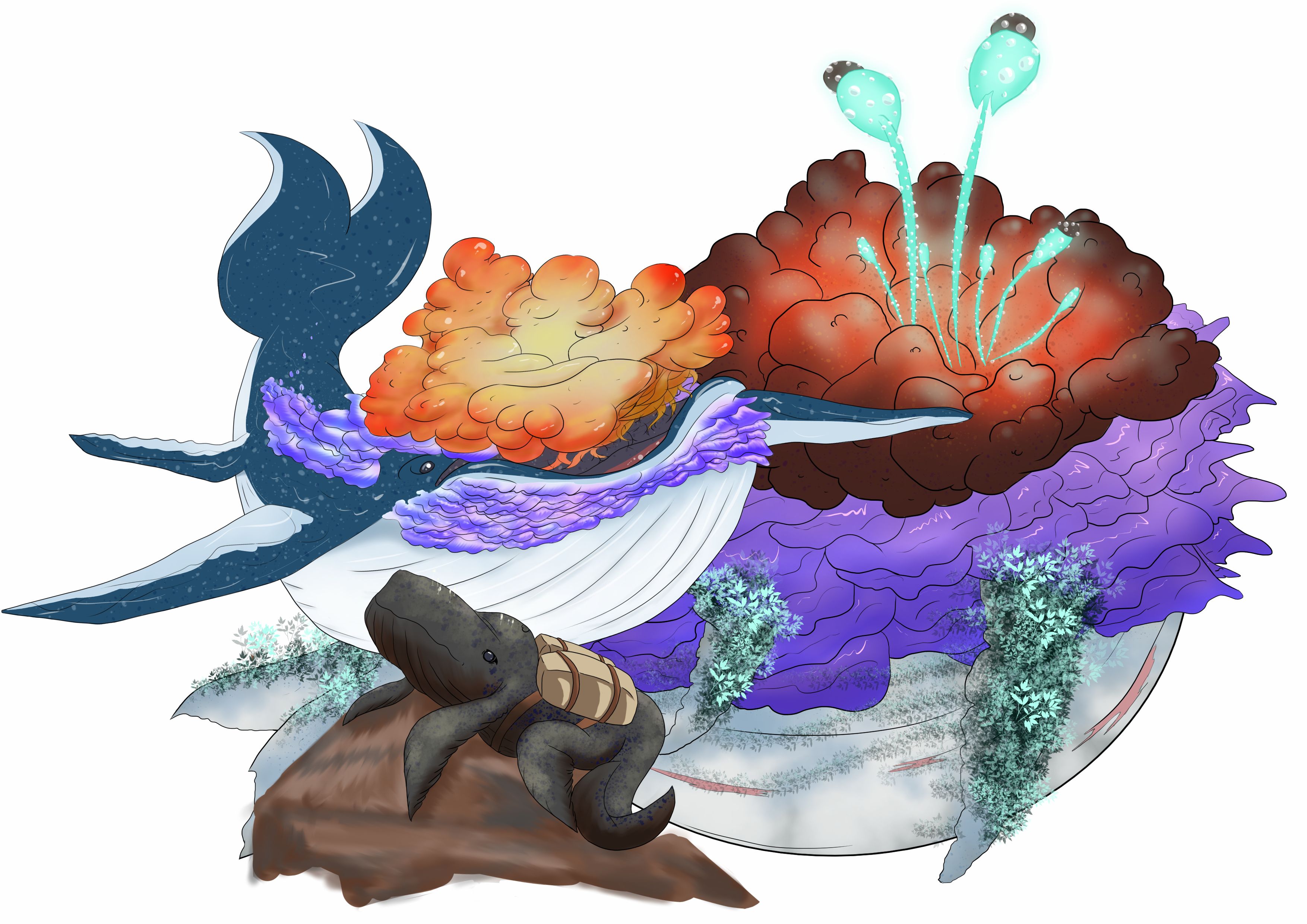
Beast of burden, machine of war, or commander of the sky. The balloon whale had been known as all of these and more throughout the ages. Majestic and mild mannered, they can be seen floating high in the skies, unconcerned with the happenings of those below.
Like most mammals, young Balloon whales rely on mother's milk to provide nutrients during their first year of life. However, since the mother is rarely able to lower her buoyancy to be within range for suckling, she will often lactate above the nest, allowing the infant to drink the fat rich liquid that pools around it. Younglings will also supplement their diet by grazing on plants.
Adult Balloon whales, being too buoyant to touch the ground, are dependent on the relationship with their parasitic fungi for nutrition. The Fungi uses chemicals in the atmosphere and through a process known as Chemosynthesis, creates nutrients the whale can consume. A byproduct of this process is a gas the whale keeps in its flight blatter, which keeps it afloat. Algae also takes up residents in the fungal bodies, which the whale consumes.
Life begins on the ground, gathered in small herds where they feed on local flora and mothers milk. However once they become infected with fungi, the whales begin the process of transitioning to life in the sky. It is unclear whether these fungi are passed from mother to offspring, or if they are ingested during their time on the ground, but at least three separate species of fungi have been observed developing on the bodies of Balloon whales. The fungi travels throughout the body via the bloodstream until it finds a suitable place to take root, where it will attach its mycelium to collect nutrients. These present as spots on the whale's body. Small fruiting bodies have been observed pushing through the skin at this stage as a possible way for the fungi to redistribute itself to more fertile parts of the body. In exchange for the nutrients, the fungi releases gasses into the bloodstream, which travel and make the adolescent buoyant, but unsteady in the sky.
As time goes on and the whale grows, so too do the fungi within it. Gasses are filtered from the bloodstream and stored into a pouch on the underside. Much like a swim bladder in fish, the whale uses muscles to move, expand, or expel the gas along its body, helping to propel it through the air. It can use a gust attachment that expels some of its gas, causing it to be less buoyant for a time. The more gas it accumulates, the more bloated its underside becomes. More of the fungi begin to push through the skin, establishing structures that collect chemicals in the atmosphere. By the time the whale is nearing sexual maturity (approx. 10 years) it is too buoyant to ever touch the ground again. It relies on the fungi to provide it with nutrients, via chemosynthesis along with algae blooms within its structures, from then on. The larger the fungi grows, the more it deforms the whale's muscle and bone structures. Fossil records of whale falls have shown massive holes in the skull, some indicating an abrupt break, while others indicate gradual bored channels.
When the fungi have reached the end of their life cycle, they create a final blooming event. The fungi stop making food, which pushes the whale to seek higher altitudes. Then the fungi push forth their fruiting bodies, releasing spores into the air in a massive cloud. The whale often hemorrhages from the final influx of gas, the pressure on its body tremendous.
Once spawned, the fungal bodies die off. If the hemorrhaging doesn't kill the whale, the starvation will. When a balloon whale dies after a spore event it is called a whale fall. They are a great source of nutrients for the ecosystems they are a part of.
It is unclear just how long they can live for, but it is estimated somewhere between 50 and 80 years, based on fossil records at whale falls. Lifespan is solely dependent upon the fungi and the whales tolerance to the continual gas buildup.
Chiroptrix have long since domesticated these beasts as convenient beasts of burden. Due to their ability to stay low or on the ground, the yearlings are traditionally utilized much like oxen to carry goods between roosts. However as the FTA began to expand, they were employed for a short time to send goods abroad. It took them little time to realize that the cost of maintaining or replacing any damaged or lost Balloon whales en route was too great. So they were retired in favor of synthetic balloons. Balloon whales are still used by the Chiroptrix along the Spine today, however they are intensely guarded and limited to roost transportation.